
Why CPA Suddenly Increased in Meta Ads (And What It Actually Means)
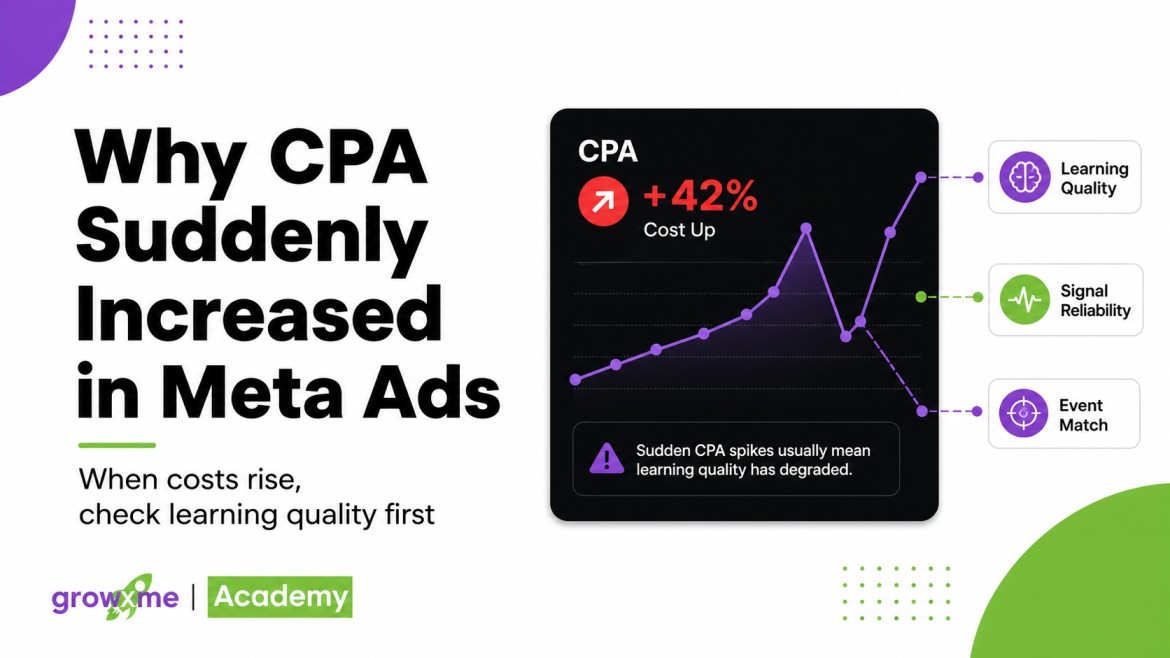
CPA usually increases suddenly when the system stops learning from reliable signals. The visible symptom is rising cost, but the deeper issue is often degraded Learning Quality across the Meta, Facebook, or Instagram ad account.
Tell me if this sounds too relevant. Your campaigns were stable. The CPA was consistent, performance was predictable, and scaling felt under control.
The account was performing amicably well and boom! Suddenly, everything changed.
CPA increased. Results became inconsistent. Costs started drifting upward without any obvious reason.
You didn’t change creatives. You didn’t change targeting. You didn’t significantly increase the budget. Yet performance broke.
Most explanations you come across point to surface-level factors. “Competition increased”, “CPMs went up”, “Seasonality changed”, etc etc.
But those explanations don’t answer the real question:
Why did CPA increase suddenly, even when nothing changed?
Rule Out the Basic Facebook Ads CPA Breakages First
Before treating a sudden CPA increase as a Learning Quality problem, check whether something simpler changed in tracking, reporting, the funnel, or the account setup.
Pixel, CAPI, purchase events, lead events, app events, or attribution settings may have changed, duplicated, stopped firing, or started reporting differently.
A checkout, form, landing page, payment step, page speed issue, or CRM handoff can raise CPA even when the ads themselves still look active.
Budget edits, optimization-event changes, attribution changes, campaign restructuring, ad rejections, or too many edits can disturb the learning environment.
We have seen sub-$100/day CBO campaigns scale profitably until a second ad set was added inside the same campaign. The new ad set pulled budget away from the winning ad set, changed the learning direction, and the original momentum broke. In both catalog and non-catalog cases, the fix was to kill or move the weak ad set so the original campaign learning could recover.
If one of these changed, fix that first. If the basics are clean and CPA still increased suddenly, the next layer is whether Meta is still learning from reliable conversion signals.
This Is Usually Not the Same as a Gradual Scaling Problem
A sudden CPA increase is different from the gradual ROAS decline that often happens when an account scales into broader demand.
With ROAS decline, the account may be reaching less efficient demand pockets, producing weaker marginal output, or needing more proof and repetition before users convert.
A sudden CPA spike is usually sharper. It often feels less like the account slowly became less efficient and more like the system started learning from weaker, noisier, or less reliable conversion feedback.
That does not mean budget edits, campaign changes, or auction pressure are irrelevant. They can absolutely contribute. But if the increase is sudden and the obvious operational issues are clean, the next layer to inspect is Learning Quality.
If your issue is ROAS falling as budget increases, that layer is explained in Why ROAS Drops When You Increase Budget.
This Is a Learning Quality Problem
When CPA increases without a clear external trigger, the issue is usually tied to how the system is learning from your data.
Learning Quality determines how reliable, consistent, and usable your conversion signals are.
The system learns from stable patterns, optimization remains predictable, and CPA stays controlled.
The system starts learning from inconsistent or noisy signals, optimization drifts, and CPA becomes unstable.
CPA spikes are often the symptom. Learning quality is usually the layer underneath.
What Actually Breaks
A sudden CPA increase is not random. It’s a signal that the system is no longer learning from clean feedback.
This usually happens when one or more of these break: conversion consistency, attribution stability, or event reliability.
These are not visible in basic dashboards, but they directly affect how the system interprets performance.
Conversion Consistency
If your conversion flow becomes irregular, the system loses pattern stability.
- uneven daily conversion distribution
- sudden drops or spikes in events
- inconsistent conversion timing
The system struggles to form reliable learning signals.
Attribution Stability
If attribution becomes noisy or delayed, feedback quality degrades.
- tracking inconsistencies
- delayed event firing
- mismatched attribution windows
The system starts optimizing from incomplete or distorted feedback.
Event Reliability
If your conversion events themselves are unreliable, learning quality collapses.
- duplicate events
- missing events
- incorrect event prioritization
The system may already be mislearning internally.
Within the HVR framework, LQ is evaluated as part of the broader readiness system alongside Signal Velocity and efficiency under expansion. The full model is explained in the HVR framework.
Why This Feels Sudden
Unlike MES problems or SV problems, LQ issues do not always degrade gradually.
They often appear as sharp CPA increases, sudden volatility, and unpredictable performance shifts.
That’s because the system crosses a threshold where learning becomes unreliable.
Once that happens, optimization deteriorates quickly.
The Learning Quality Breakdown Loop
Most accounts make CPA spikes worse because they react to the symptom before identifying the learning breakdown.
Where Signal Velocity Still Plays a Role
Even though this is not primarily a Signal Velocity problem, SV can amplify the issue.
Signal Velocity refers to how consistently your account generates conversion signals over time.
If signal flow is already low, the account has fewer conversion events, less data density, and weaker feedback loops.
Then any drop in learning quality has a larger impact. This is why CPA spikes are often worse in low-volume accounts.
This is where the Data Starvation Loop starts to appear.
Low signal volume gives the system less reliable feedback, and weak feedback makes every learning-quality issue more expensive. The full loop is explained inside the HVR framework.
If you want to understand how signal flow interacts with learning stability, see Signal Velocity in Paid Ads.
Not All CPA Increases Are the Same
There are two types of CPA increase.
Aligned with budget or scaling, predictable trend, and linked to efficiency decay.
Usually an MES issueSharp increase in cost, unstable performance, and no clear external cause.
Usually an LQ issueWhy Most Facebook And Instagram Ad Accounts Misdiagnose This CPA Spike
Most marketers respond to CPA spikes by changing creatives, adjusting targeting, or modifying budgets.
These actions assume the problem is external.
But if the issue is learning quality, these changes don’t fix the root cause.
Before making more edits or increasing spend, the account needs cleaner signal conditions. That process is explained in how to stabilize Meta Ads before scaling.
When the system learns from noisy feedback, cost control becomes unstable.
They often make the system more unstable.
What Actually Determines CPA Stability
CPA stability depends on whether your system can maintain consistent conversion flow, reliable attribution, and clean event data across Meta Ads Manager, Facebook placements, Instagram placements, and your actual store or CRM.
Consistent Conversion Flow
The account needs enough regular conversion activity for the system to identify stable patterns.
Reliable Attribution
The system needs feedback that is not delayed, distorted, or mismatched across windows.
Clean Event Data
Conversion events need to be correctly fired, prioritized, and passed back to the platform.
If these remain stable, learning remains stable. If they degrade, CPA becomes unpredictable.
Where the High Velocity Readiness (HVR) Framework Comes In
Learning Quality is one part of the broader system.
Can the system learn fast enough?
Is the system learning from reliable signals?
Does performance hold under scale?
CPA spikes are usually a failure in the second layer. But they often interact with the other two.
Explore the HVR Framework → Book An HVR Audit →CPA Jumped And The Story Still Doesn’t Add Up?
If CPA jumped and the account story is unclear, a Meta Ads Audit can help separate market pressure from campaign structure, signal quality, tracking, creative fatigue, offer friction, or agency-side account decisions.
Final Takeaway
CPA does not increase suddenly without a reason. When it happens without clear changes, it usually means the system is no longer learning from reliable signals.
Not just a creative problem. Not just a competition problem. Not just the platform being random.
A signal integrity problem where Learning Quality determines whether performance can remain stable.
If that breaks, everything else follows.
TL;DR
A sudden CPA increase is not always competition, CPM pressure, or creative fatigue. Those can contribute, but the deeper issue is often weakened Learning Quality.
For Meta, Facebook, or Instagram ad accounts, check tracking, conversion consistency, attribution stability, recent budget or structure changes, and whether the system is still learning from reliable purchase or lead signals.
Use a Meta Ads Audit for the immediate diagnosis. Use the HVR layer when the question becomes whether the account is structurally ready to scale, hold, stabilize, or reset.
FAQ
Why did my CPA suddenly increase in Meta Ads?
CPA usually increases suddenly when the system starts learning from less reliable signals. The deeper layer is Learning Quality, which is explained in this article and inside the HVR framework.
Why did my Facebook Ads CPA suddenly increase?
Facebook Ads CPA can suddenly increase when budget shifts, tracking breaks, conversion flow thins out, new ad sets disrupt a working campaign, or Meta starts learning from weaker signals. If the team calls it an FB Ads CPA problem, check the same layers: campaign history, ad set budget distribution, event quality, and whether Instagram or Insta Ads placements changed the traffic mix.
Is a CPA spike always caused by competition or CPM increases?
Not always. Competition and CPMs can contribute, but sudden CPA spikes often point to signal instability or degraded learning quality.
What should I check first when CPA spikes?
Check whether conversion consistency, attribution stability, or event reliability changed. These are the three learning-quality layers that affect CPA stability.
How is a CPA spike different from ROAS dropping during scaling?
ROAS decline during scaling is often an MES issue. A sudden CPA spike without obvious changes is more likely tied to Learning Quality. The MES layer is covered in Why ROAS Drops When You Increase Budget.
How does Signal Velocity affect CPA spikes?
Low Signal Velocity gives the system fewer usable conversion signals. When Learning Quality also degrades, CPA instability can compound faster. The signal layer is explained in the Signal Velocity guide.
When should I get a Meta Ads Audit for a CPA spike?
Book a Meta Ads Audit when CPA increased suddenly and the cause is not obvious from campaign edits, tracking, funnel changes, creative fatigue, or placement quality. The audit is meant to separate market pressure from account structure, signal quality, tracking, and learning issues.