
How to Maintain Signal Velocity While Scaling Ads
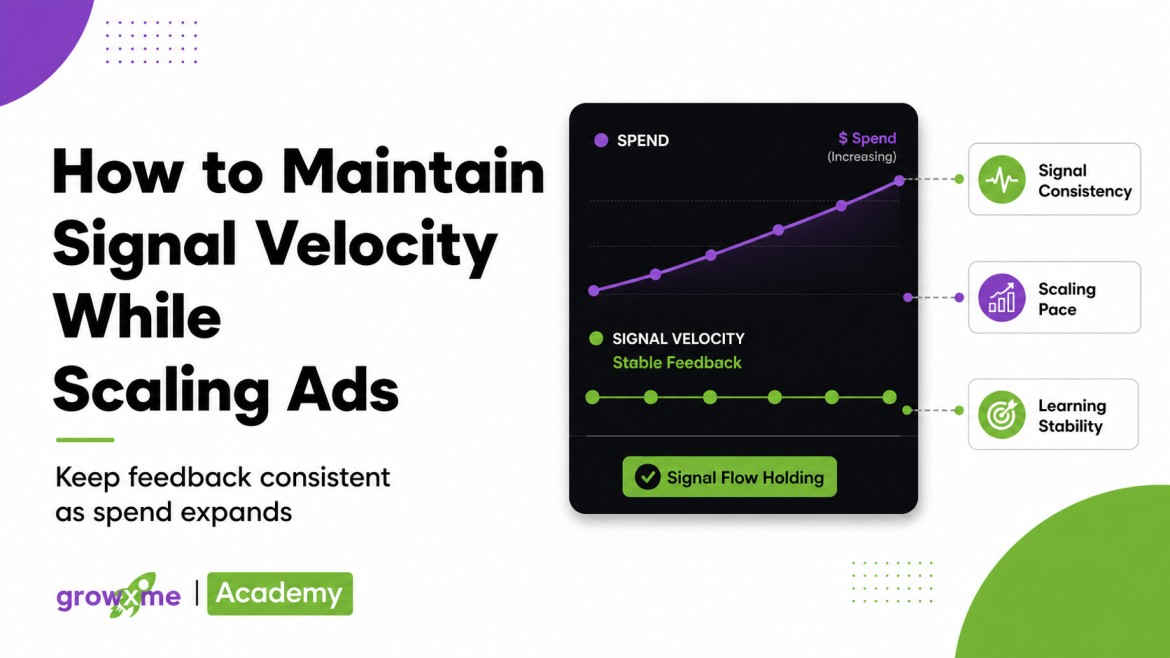
Scaling does not create stability. It exposes whether stability already exists. If Signal Velocity is weak before scaling, increasing budget usually amplifies the weakness.
There’s a common assumption in ad scaling. If something is working, you increase the budget and expect more of the same.
But when it doesn’t, the explanation is usually simple.
“You scaled too fast.”
That’s part of the story. But not the full one.
Because performance doesn’t just change due to what you do. It also changes based on how your system responds when conditions shift.
Meta algorithm updates, Facebook and Instagram auction volatility, CPM spikes, competitor pressure, and seasonal shifts can disrupt performance even when nothing in the account changes. It’s been a sad reality of 2025, I admit.
The real question isn’t “Why did performance change?” It’s “Why did this account react the way it did?”
Before focusing on Signal Velocity, rule out the basics: make sure tracking is clean, conversion events are firing properly, the landing page, checkout, app flow, or lead form has not changed, the offer is still valid, and recent campaign edits have not disrupted learning. Signal Velocity becomes useful once the account is operationally stable enough to diagnose.
Scaling Doesn’t Just Increase Spend
One thing to remember is that when you increase the budget, you’re not just spending more.
You’re effectively changing how the system receives feedback. You reach broader segments, conversion behavior becomes less predictable, and signals don’t come in with the same consistency as they did before.
If the system was already operating on thin or inconsistent signal flow, this expansion exposes it immediately.
This is not the system breaking, it’s actually revealing its limits.
Scaling doesn’t create stability. It exposes whether stability already exists. If Signal Velocity isn’t stable before scaling, scaling will break it faster.
Where Signal Velocity Fits
Platforms like Meta learn from feedback. In day-to-day language, this is the same learning layer behind Facebook Ads, FB Ads, Instagram Ads, and Insta Ads. You may know this feedback as signals such as purchases, installs, signups, etc.
When that feedback is consistent, the system adapts. But when it becomes uneven, learning weakens.
We refer to this as Signal Velocity. But it’s important to be precise about what that means.
Signal Velocity is not about how many conversions you get. It is about how consistently those conversions come in over time.
A campaign generating 10 conversions every day steadily is far easier for the system to learn from than one generating 30 conversions in bursts and then going quiet.
The system does not just need volume. It needs consistency in how that volume arrives.
Signal Velocity does not explain why performance suddenly drops. External factors can absolutely trigger that.
It explains whether the system can continue learning when those changes happen.
You don’t control platform volatility. But you do control how resilient your system is to it.
Why Some Accounts Break and Others Don’t
This is where I believe most scaling discussions fall short. Two accounts can experience the same external conditions: the same platform environment, similar competition, and similar timing.
But they behave very differently. One stabilizes after a dip, while the other becomes unpredictable.
The difference is rarely just the algorithm. It’s whether the system had enough signal consistency to absorb the change.
Signal flow is consistent, learning continues, and the account can absorb volatility without overreacting.
Signal flow is irregular, feedback becomes noisy, and every external shift creates a larger reaction.
If your system cannot generate signals consistently at a higher spend level, increasing budget won’t scale performance. It will amplify instability.
If your conversion volume doesn’t scale with spend, you’re not really scaling. You’re diluting the signal.
A Common Failure Pattern
We recently saw this in a high-ticket pre-order campaign we consulted on.
Budgets were being changed aggressively by the previous agency:
$100 → $400
$1500 → $1200 → $1000
It was all done within a very short time span. The expectation was that performance would stabilize after each adjustment. But it didn’t.
Now, external factors could absolutely have played a role. Auction conditions, platform changes, even offer dynamics. But the system response made the situation worse.
The account wasn’t generating enough signals to begin with: high CPAs, slow feedback cycles, shallow top-of-funnel. So every budget change forced the system to react without a stable base.
Without consistent signals the system doesn’t adapt, it oscillates.
When Aggressive Scaling Actually Works
There are cases where larger jumps don’t break performance. But they don’t work randomly.
We recently scaled a campaign for a brand with a fresh Meta account from $45 to $55/day. On paper, that’s a relatively aggressive jump at that level.
~50% increase in conversions
~50% reduction in CPA over the next few days
This wasn’t because the platform suddenly became favorable or because aggressive scaling works. It was because the system was already strong.
Signal flow was consistent. Feedback was clean and learning was stable.
When external conditions shift, systems like this tend to absorb the impact. They don’t do it perfectly, but predictably. And that’s what we want.
The Real Job During Scaling
Scaling isn’t about pushing budget. Think about it as managing how the system learns while the conditions change.
Before that budget increase happens, the system also needs to be stable enough to interpret. That pre-scale layer is covered in how to stabilize Meta Ads before scaling.
Pace Expansion
Increase spend at a pace signal generation can support.
Maintain Signal Consistency
Make sure feedback remains stable as the account reaches broader segments.
Avoid Unnecessary Disruption
Limit major account changes during already volatile periods.
Because when external volatility hits — and it will — the system either absorbs it or amplifies it.
What You Should Take Away From This
Meta can be volatile, auction conditions can change, and performance can shift even when nothing obvious breaks.
But not every account reacts the same way. Scaling doesn’t break ads. And platform changes don’t fully explain outcomes either.
What matters is whether your system can keep learning through change.
Most instability doesn’t come from scaling too fast. It comes from scaling a system that wasn’t resilient enough to handle it.
Where This Fits
Signal Velocity is usually the first constraint you hit. Efficiency and learning quality tend to break after.
Together, these determine whether your system stabilizes or drifts when conditions change.
If you want a deeper breakdown of how signal flow works structurally, read Signal Velocity in Paid Ads.
Book An HVR Audit →Campaigns Getting Unstable As You Scale?
If performance keeps drifting as spend increases, the issue is usually not just what changed externally. It’s how the account responded internally.
A Meta Ads Audit maps where signal flow, efficiency, and learning start breaking, especially under real market conditions.
Key Principles for Scaling Without Breaking Signal Flow
If you’re scaling campaigns, a few principles tend to hold across most accounts:
If your conversion volume doesn’t scale with spend, you’re not scaling. You’re diluting signal.
Scaling doesn’t create stability. It exposes whether stability already exists.
External volatility is unavoidable. The question is whether your system can keep learning through it.
If performance becomes inconsistent over a few days instead of breaking instantly, it’s often a signal flow issue, not a creative issue.
Aggressive scaling only works when signal flow is already strong.
If the system starts reacting instead of adapting, signal consistency has likely broken.
TL;DR
Signal Velocity is not just conversion volume. It is the consistency of useful conversion feedback as spend expands.
If Facebook Ads, Instagram Ads, or Meta campaigns become unstable during scaling, check whether signal flow stayed steady, whether tracking stayed clean, and whether budget changes outpaced the account’s ability to learn.
Aggressive scaling can work when the system is already strong. If the system is thin or noisy, more budget usually amplifies the weakness.
Not Sure Why Signal Quality Is Weakening?
If performance is becoming harder to read, the issue may not be signal velocity alone. Use this diagnostic bridge to separate account execution, offer friction, market pressure, and business-fit problems before making the next scaling decision.
FAQ
What does it mean to maintain Signal Velocity while scaling?
Maintaining Signal Velocity means keeping conversion feedback consistent as you increase spend. It is not just about getting more conversions, but about making sure signals arrive steadily enough for the system to keep learning. You can read the full concept here: Signal Velocity in Paid Ads.
Does scaling too fast always break performance?
Not always. Aggressive scaling can work when the system state is already strong, signal flow is consistent, and feedback is clean. The problem starts when budget increases faster than the account can generate usable signals.
Does this apply to Facebook Ads and Instagram Ads?
Yes. Signal Velocity applies across Meta placements, including Facebook Ads, FB Ads, Instagram Ads, and Insta Ads. The placement mix can change, but the core question stays the same: can the account keep generating useful conversion feedback as spend increases?
Can Meta algorithm updates still affect performance?
Yes, platform changes, auction shifts, CPM movement, and seasonality can all affect performance. The better question is whether your account can keep learning when those shifts happen. That is where signal flow, efficiency, and learning quality matter.
How do I know if instability is signal-related?
If performance becomes inconsistent over a few days, CPA fluctuates, and delivery becomes harder to predict, signal flow may be part of the issue. Creative or market factors can still be involved, but unstable feedback often explains why the system struggles to recover.
How does Signal Velocity connect to the HVR framework?
Signal Velocity is one of the first constraints inside High Velocity Readiness. It helps explain whether the system can keep learning during scale. The broader HVR framework also looks at efficiency and learning quality to understand whether an account is structurally ready to scale.