
How to Stabilize Meta Ads Before Scaling
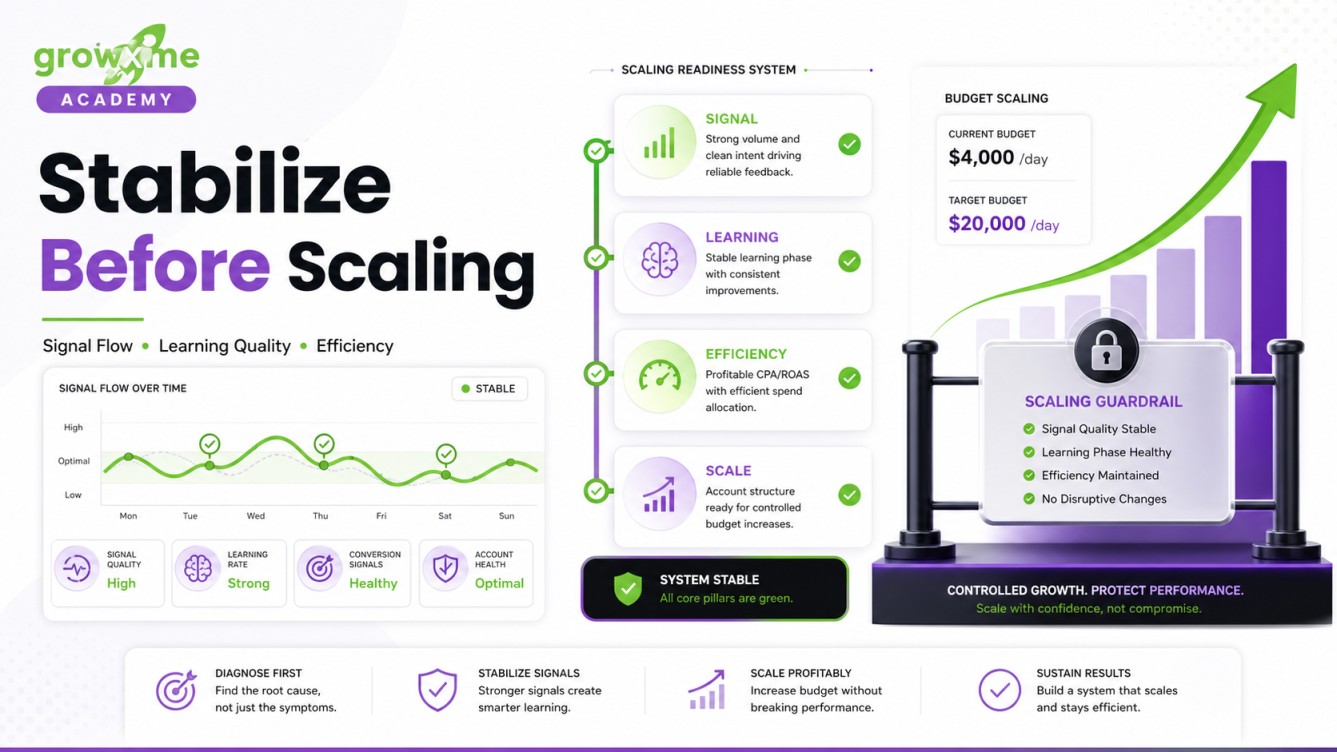
Stable metrics do not always mean the system is stable. Before increasing budget, the Meta, Facebook, or Instagram ad account needs clean signal flow, reliable learning, and enough efficiency under pressure to handle expansion.
There’s a common mistake that happens when Meta Ads start performing well.
Here’s how it looks: CPA looks acceptable, ROAS is in range, and purchases are coming in. The campaign has been stable for a few days, so the next move feels obvious.
Increase the budget.
And sometimes that works. But a lot of the time, the moment you scale, the account starts behaving differently. CPA rises, ROAS softens, and delivery becomes uneven. What looked stable suddenly starts reacting.
The easy explanation is:
“You scaled too early.”
That may be true. But it’s not the full explanation.
Because the real issue is usually not the budget increase itself. It’s that the system wasn’t stable enough before the budget increase happened.
The question is not: “Were the numbers good enough to scale?” It’s: “Was the system stable enough to handle more pressure?”
Stable Facebook Ads Performance Is Not the Same as a Stable System
This is where a lot of scaling decisions go wrong.
A campaign can look stable on the surface while the system underneath is still fragile.
Maybe one creative is carrying most of the result. Maybe conversion volume is too low to trust. Maybe sales are coming in bursts. Maybe performance is being supported by a narrow audience pocket that hasn’t been stressed yet.
On paper, the campaign looks fine.
But once you increase ad spend, Meta has to find more people, enter more auctions, and expand beyond the easiest conversion opportunities. That changes the conditions the system is learning from.
If the system was only stable inside a narrow pocket, scaling exposes that immediately.
Scaling does not create instability from nowhere. It usually reveals instability that was already there.
And that’s why stabilizing before scaling matters.
What Stabilization Actually Means
Stabilization does not mean waiting three days and hoping the campaign “settles.”
Sometimes waiting is useful. But waiting alone does not fix weak signal flow, noisy learning, or fragmented account structure.
What stabilization actually means is making the system easier to read before you ask it to grow.
You’re trying to understand whether the performance you’re seeing is repeatable, or whether it is being held together by short-term variance.
A stable account should not need constant edits to stay alive. It should not depend on one unusually strong day. It should not collapse every time budget pressure increases slightly.
What this usually indicates is simple:
If the system can’t repeat performance under current conditions, it probably won’t hold under expanded conditions.
The Three Things That Need to Stabilize
Before scaling, three layers usually need to be stable enough to trust.
Meta needs consistent feedback from purchases, leads, installs, or whatever conversion event you are optimizing for. If those signals arrive unevenly, the system has a harder time identifying reliable patterns.
The system has to learn from signals that actually represent useful behavior. If events are delayed, attribution is noisy, or conversion paths keep changing, the algorithm may optimize from weak feedback.
Even if CPA is good right now, you still need to know whether added spend is likely to produce incremental output or simply push the account into lower-quality demand.
CPA and ROAS show the outcome. Stabilization asks whether the system producing that outcome can keep producing it when conditions change.
Where Most Accounts Misread Stability
Most teams look at recent performance and ask: “Is this good enough to scale?”
But recent performance can be misleading.
A few profitable days may come from a strong creative, a warm audience pocket, a timing advantage, or a temporary auction condition. That does not always mean the account is structurally stable.
This is where things start breaking.
The system is not necessarily improving. It may simply be operating inside the easiest part of the market.
$100/day
4 purchases at a $25 CPA
Looks stable on paper
3 purchases came from one creative
Demand came from one warm pocket
Performance depended on one unusually strong day
When spend moves to $150 or $200 per day, Meta has to find additional conversion opportunities outside that easy pocket.
That’s when CPA can jump, not because the campaign suddenly became bad, but because the system was never stable across a broader demand base.
So when performance drops after scaling, it may feel like the budget increase broke the campaign.
But often, the budget increase only revealed that the campaign was not stable enough to scale in the first place.
We have seen low-budget CBO campaigns lose momentum after a second ad set was added inside the same campaign. The new ad set absorbed spend, the winning ad set lost budget, and the learning direction changed. The issue was not that Facebook Ads or Instagram Ads suddenly became bad. The account structure made a working system harder for Meta to read.
Signs Your Account Is Not Ready Yet
You don’t need to overcomplicate this. There are a few patterns that can suggest the account needs stabilization before scale.
None of this means the account is doomed. It just means the system may not be ready for more pressure yet.
And if you scale a system that is not ready, you usually don’t get controlled growth. You get amplified instability.
Surface stability can hide system fragility. Scaling expands delivery and changes feedback conditions. If signal flow, learning quality, or efficiency are weak, budget pressure exposes them.
Before increasing budget, the job is to reduce noise and make the system easier to interpret.
What to Do Before Increasing Budget
Your first job is to reduce noise.
Or said another way, improve the conditions for cleaner signal flow.
That usually means fewer unnecessary variables, fewer reactive edits, and a cleaner structure for the system to learn from.
If budget is spread too thin across campaigns, ad sets, creatives, or products, the account may not generate enough useful feedback anywhere. Consolidation helps signal density improve.
If weak ad sets are consuming spend without producing meaningful feedback, they may need to be removed or paused.
If creative testing is happening too aggressively while the account has low signal volume, the tests may be creating more confusion than learning.
If events are unreliable, fixing tracking comes before scaling.
This is not about making the account smaller for the sake of simplicity. It’s about making the account readable.
You cannot scale what you cannot interpret.
Once the structure is cleaner, the next step is to observe whether the system can repeat performance without constant intervention.
That is where stabilization actually starts.
A Simple Stabilization Sequence
A practical sequence usually looks like this:
Reduce fragmentation.
Remove unstable inputs.
Consolidate spend into clearer learning paths.
Watch whether signal flow becomes more consistent.
Validate whether CPA, ROAS, and conversion volume hold.
Increase budget only after the system holds.
The order matters.
If you scale before reducing fragmentation, you may spend more without improving learning.
If you add more creatives before signal flow is stable, you may create more noise.
If you judge readiness from short-term ROAS alone, you may mistake variance for stability.
Stabilization is not about being slow. It’s about making the next decision clearer.
When Holding Budget Is the Right Move
Sometimes the best scaling decision is to not scale yet.
Let that sink in for a second.
That sounds unexciting, but it’s often the right call.
If CPA is good but conversion volume is too low, hold.
If ROAS is strong but comes from uneven purchase timing, hold.
If the account recently had major changes, hold.
If one creative is carrying everything, hold.
If signal flow is improving but not consistent yet, hold.
Holding budget is not passive when there’s a reason behind it.
You are giving the system a chance to prove whether the current performance is repeatable. If it holds, scaling becomes safer. If it breaks, you have avoided putting more spend into a weak state, saving your capital.
Not every good result deserves more budget immediately. Some good results need validation first.
When Stabilization Is Not Enough
There are also cases where small cleanup is not enough.
If the account is too fragmented, tracking is unreliable, objectives are misaligned, or the system cannot generate enough meaningful signals to diagnose anything, stabilization may require a reset.
A reset does not mean starting over blindly.
It means rebuilding the structure so the system becomes interpretable again.
Sometimes that means simplifying campaigns. Sometimes it means changing the conversion event. Sometimes it means rebuilding around fewer, stronger inputs instead of trying to rescue every existing variable.
The point is not to erase history. The point is to restore signal clarity.
Where This Fits Inside HVR
Inside the HVR framework, stabilization happens before scale validation.
Signal Velocity tells you whether feedback is arriving consistently enough for the system to learn.
Learning Quality tells you whether that feedback can be trusted.
Marginal Efficiency of Scale tells you whether added spend is likely to remain efficient or start decaying.
Stabilization is what you do before asking those layers to handle more pressure.
If Signal Velocity is weak, scaling creates dilution.
If Learning Quality is unstable, scaling creates noisier learning.
If efficiency is already fading, scaling pushes the account faster into lower-return demand.
That is why HVR does not treat good CPA or ROAS as enough by themselves.
The system has to be stable before the budget increase.
Book An HVR Audit →What You Should Take Away From This
You do not stabilize Meta Ads by waiting for the numbers to look better.
You stabilize by reducing noise, improving signal consistency, and making the account easier to interpret before applying more spend.
If performance only holds under narrow conditions, the system is not ready yet.
If the account can maintain signal flow, learning quality, and efficiency without constant intervention, scaling becomes more controlled.
The goal is not to scale because the numbers look good.
The goal is to scale because the system has proven it can handle more pressure.
Final Note
If your Meta Ads keep breaking after every budget increase, the issue usually isn’t just the increase itself.
It’s the state of the system before the increase happened.
That’s what we look for in our audits: whether the account is actually stable enough to scale, or whether performance is being held together by conditions that won’t survive expansion.
Key Principles for Stabilizing Meta Ads Before Scaling
Stable metrics are not the same as a stable system.
If performance depends on one creative, one product, or one audience pocket, scaling may expose that weakness.
Budget increases amplify the system state that already exists.
More testing does not fix weak signal density if it adds more fragmentation.
Holding budget can be an active decision when the system needs validation.
A reset is useful when the current structure prevents clean interpretation.
The best scaling decisions happen after the account becomes readable.
TL;DR
Stabilizing Meta Ads before scaling means making the account readable before asking it to handle more budget. Good CPA or ROAS is not enough if the system depends on one fragile creative, one narrow audience pocket, weak signal flow, or unstable learning quality.
Before increasing spend, check whether conversion feedback is consistent, tracking is reliable, account structure is simple enough to learn, and efficiency still holds when pressure increases. If the account breaks every time budget goes up, diagnose the system before scaling again.
Account Looks Profitable But Breaks When Budget Goes Up?
If your account looks profitable but keeps breaking when budget increases, the next step is not more guessing. It is a system diagnosis.
GrowXme audits where signal flow, learning quality, and efficiency start breaking before deciding whether the account should scale, stabilize, or reset.
FAQ
How long should Meta Ads stabilize before scaling?
There is no universal number of days. What matters is whether the account has generated enough consistent feedback to trust the pattern. If conversions are uneven, CPA is drifting, or results depend on one unstable input, the system may need more validation before scaling. For the signal layer behind this, read the Signal Velocity guide.
What does it mean to stabilize Meta Ads?
Stabilizing Meta Ads means reducing noise so the system can learn from cleaner signals. This usually involves consolidating fragmented spend, removing unstable inputs, improving event reliability, and giving the account enough time to prove whether performance is repeatable. This connects closely to how you maintain Signal Velocity while scaling.
Should I scale if CPA is profitable?
Not automatically. Profitable CPA shows that the current state is working, but it does not prove the system can absorb more budget. If signal flow is weak or performance depends on a narrow demand pocket, scaling can still create instability. Sudden cost movement is usually explained better through the CPA spike breakdown.
Is it better to test more creatives before scaling?
Only if the account has enough signal density to interpret the tests. If signal flow is already weak, adding more creatives can fragment learning further. Creative testing works best when the system has enough feedback to separate real patterns from noise. If scaling also hurts efficiency, read why ROAS drops when budget increases.
When should I reset instead of stabilize?
A reset may be needed when the current structure makes the account hard to interpret. This usually happens when budgets are fragmented, events are unreliable, objectives are misaligned, or the account cannot generate enough meaningful signal to diagnose performance clearly. The goal is not to erase history, but to restore signal clarity.
How does stabilization connect to HVR?
Stabilization prepares the account for scale-readiness evaluation. It helps bring Signal Velocity, Learning Quality, and efficiency into a cleaner state so HVR can determine whether the system should scale, hold, stabilize further, or reset. The full diagnostic model is explained in the HVR framework.