
What Is Signal Velocity in Meta Ads? (And Why Facebook Ad Scaling Breaks Without It)
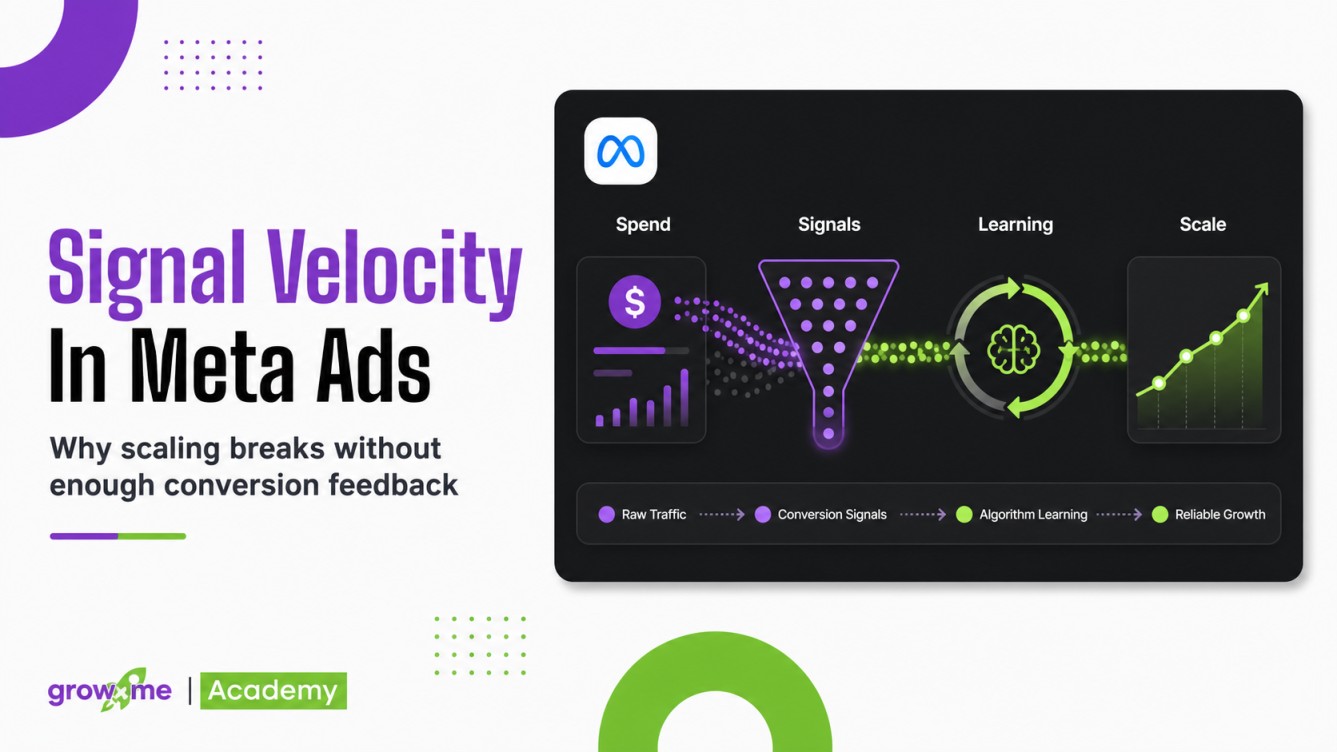
Signal Velocity (SV) is the rate at which a paid acquisition system generates conversion signals over time. In platforms like Meta Ads, Facebook Ads, Instagram Ads, and Google Ads, it determines whether your campaigns are producing enough signal density for the algorithm to learn, optimize, and scale reliably.
Most advertisers evaluate paid ad scaling using CPA or ROAS. Those are outcome metrics. Signal Velocity measures the strength and timing of the feedback loop behind those outcomes.
Check Your Signal Velocity Before You Scale
Most Meta Ads campaigns do not fail because the creative is bad or the targeting is wrong. The same is true when teams describe the problem as Facebook Ads, FB Ads, Instagram Ads, or Insta Ads failing after a budget increase. They fail because the system is scaled before it has enough signal density to support learning.
Before increasing budget, you need to know whether your account is generating enough conversion signals, whether the system is statistically interpretable, and whether you are scaling inside a fragile learning state.
–
Reality check: In one Shopify account, Meta attributed 69 sales while the client-side UTM view showed only 14 orders. A deeper attribution breakdown showed a large share coming from 1-day view and engaged-view attribution, which made the account look cleaner than the store-side evidence suggested. That is why Signal Velocity needs attribution quality beside it, not just event count.
What next?
Use your calculator result as a diagnostic starting point, not a standalone scaling decision. Then move to the next layer that fits your situation.
Why Most Paid Ad Scaling Decisions Are Structurally Wrong
Most advertisers scale Meta Ads campaigns based on CPA or ROAS. The problem is not that these metrics are useless. The problem is that they are incomplete.
CPA and ROAS describe outcomes. They do not describe the structure producing those outcomes. Two campaigns can show identical CPA and ROAS while behaving completely differently under scaling pressure.
The difference is not performance. It is signal structure.
Why Scaling Meta Ads Breaks When Signal Velocity Is Low
Scaling does not fail randomly. It breaks through a predictable chain of events:
- Low Signal Velocity creates delayed feedback
- Delayed feedback weakens learning stability
- Weak learning pushes delivery into lower-quality conditions
- Lower-quality delivery increases CPA and destabilizes paid ad scaling
Inside the GrowXme framework, this sits inside the broader failure pattern of the Data Starvation Loop. Read the full HVR framework →
Signal Velocity Formula
Signal Velocity measures how frequently conversion events occur.
This is not a total. It is not a summary metric. It is a rate. The algorithm responds to how often signals arrive, not just how many exist on paper.
Clusters of conversions indicate strong signal flow. Long gaps indicate system cooling.
Signal Velocity Alone Does Not Determine Scaling Readiness
Signal Velocity is the foundation layer of the system, but it is not the full model. Paid ad scaling depends on whether signal is not only fast enough, but also dense enough, trustworthy enough, and efficient enough under spend expansion.
Signal Confidence Layer (SCL)
SCL normalizes Signal Velocity against a working benchmark.
SCL < 1 suggests an underfed system. SCL ≈ 1 suggests the minimum stable learning threshold. SCL > 1 suggests stronger signal flow.
Data Density Floor (DDF)
The Data Density Floor is the minimum signal required for reliable interpretation.
Below this level, performance may exist, but the conclusions you draw from it are unreliable.
Signal Velocity is only one layer
Signal Velocity tells you whether the system is producing enough signal to be interpreted. HVR tells you whether that system is actually ready to scale.
Signal Velocity Inside the Signal-Velocity Matrix
Signal Velocity becomes more meaningful when paired with Learning Quality. This is where the system stops being a raw volume problem and becomes a state diagnosis problem.
Signal Velocity does not determine performance. It determines which failure mode your paid ads system is operating in.
Where Signal Velocity Fits in Paid Ad Scaling Systems
Signal Velocity is the speed layer inside the HVR framework.
- SV determines whether the system reaches DDF
- DDF determines whether Learning Quality can be trusted
- Learning Quality and NNSI define system state
- MES determines whether scaling remains efficient
This is why Signal Velocity alone cannot tell you whether to scale your Meta Ads campaigns. Read the full HVR system →
What This Looks Like in Practice
The anime brand case study shows why structure matters before scale
In our anime-focused eCommerce Meta Ads case study, growth was not achieved by blindly increasing budget. It was achieved by stabilizing the system first: improving signal flow, maintaining data density, and scaling without breaking CPA constraints.
That matters here because Signal Velocity is not an abstract theory. It is part of how real paid ad scaling either holds or collapses under pressure.
Explore the full system
Use this page as the Signal Velocity node inside the broader GrowXme system. Then move into the part of the framework that matches your next question.
TL;DR
If Meta Ads, Facebook Ads, or Instagram Ads break after scaling, the issue may not be one bad creative. The system may be underfed, noisy, or learning from weak conversion signals.
Use Signal Velocity to understand the signal layer. Use HVR or an audit when the bigger question is whether the account should scale, stabilize, hold, or reset.
Frequently Asked Questions
What is Signal Velocity in Meta Ads?
Signal Velocity measures how quickly conversion events occur over time in a Meta Ads account. It reflects the strength of the feedback loop the algorithm uses to optimize performance.
What is a good Signal Velocity for paid ad scaling?
A common working benchmark is around 50 conversions per week, or roughly 0.3 conversions per hour. That said, scaling readiness depends on how this signal interacts with data density, Learning Quality, and the broader system structure.
Why do Meta Ads campaigns stop working when I increase budget?
Scaling increases pressure on the system. If Signal Velocity is too low, the algorithm loses confidence, delivery becomes unstable, and CPA often rises as the system explores weaker conditions.
Can good ROAS hide weak Signal Velocity?
Yes. Surface performance can look stable while the underlying signal structure remains weak. This is one reason paid ad scaling often appears healthy right before it breaks.
What does the Signal Velocity calculator actually tell me?
The calculator estimates whether your system is below the Data Density Floor, near interpretability, or strong enough for meaningful diagnosis. It does not replace the full HVR framework or make a complete scaling decision on its own.
Does Signal Velocity alone determine whether I should scale my ads?
No. Signal Velocity is a prerequisite for diagnosis, not a complete readiness metric. True scaling readiness depends on how signal interacts with Learning Quality, Net New Signal Inflow, and efficiency at scale.