
Why ROAS Drops When You Increase Budget
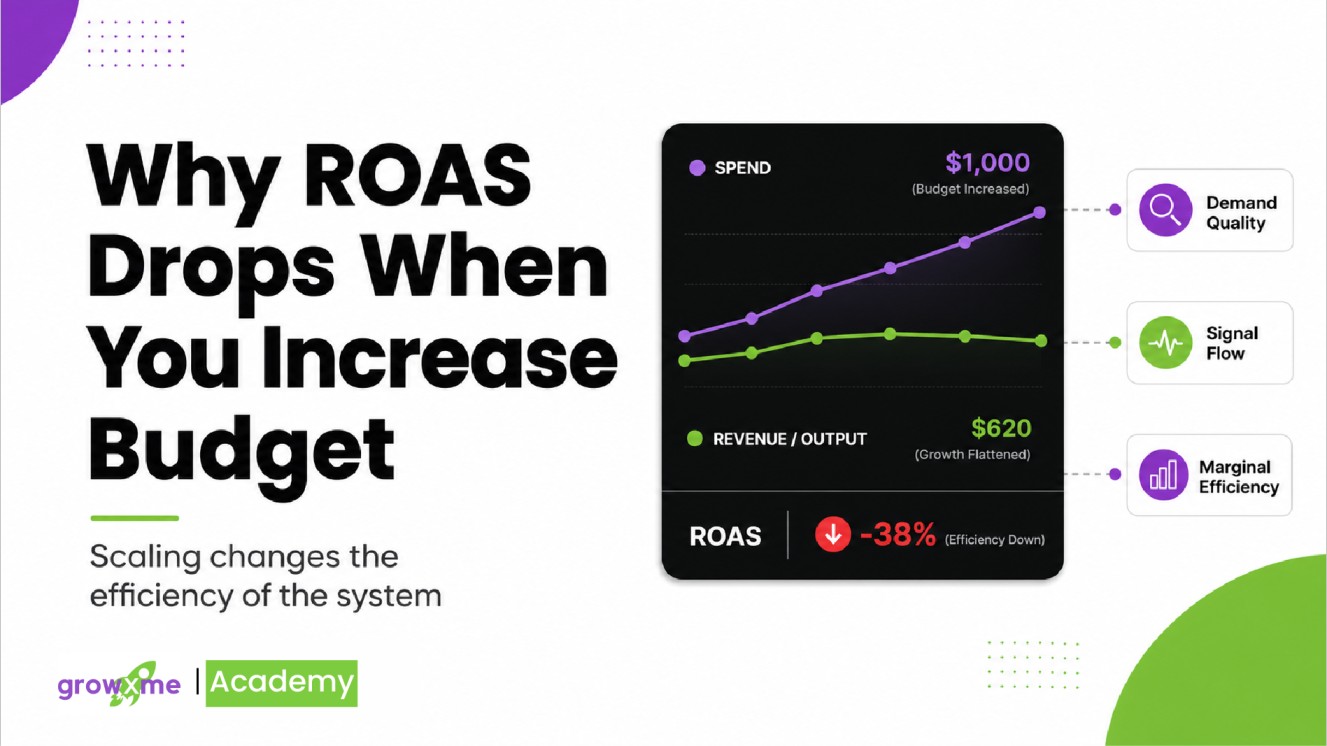
ROAS drops when you increase budget because scaling changes the environment your campaign operates in. This can happen across Meta Ads, Facebook Ads, FB Ads, Instagram Ads, and Insta Ads when the account moves beyond its most efficient demand pockets, loses signal consistency, or hits a point where added spend produces weaker incremental output.
ROAS usually does not drop because one isolated part of the account suddenly broke, although there are exceptions. Reporting can get distorted by tracking issues, performance can soften after a major creative or offer change, and external pressure from seasonality, competition, or rising CPMs can make the same revenue harder to buy profitably.
But when ROAS starts dropping after a budget increase, the more useful diagnosis usually starts inside the system.
The account may have moved beyond its most efficient demand pockets. It may be generating fewer useful conversion signals at the new spend level. The budget increase may have happened faster than the account could stabilize, or the campaign may now be reaching a broader audience that needs more education, proof, and repetition before converting.
That is why this problem of dropping ROAS is often misunderstood. The visible symptom may be the ROAS drop, but the underlying issue is usually a change in marginal efficiency (MES), signal quality (SV/SVM), learning stability (LQ), or demand quality (NNIS).
This article expands on a shorter observation originally shared in the Facebook Ads subreddit, where this ROAS drop pattern comes up often among advertisers trying to understand why scaling suddenly feels less predictable.
Rule Out the Basic Facebook Ads ROAS Breakages First
Before treating a ROAS drop as a scaling, marginal efficiency, or demand-quality problem, check whether something simpler changed in the account, offer, or conversion path.
Pixel, CAPI, purchase events, attribution settings, or reporting windows may have changed how revenue and conversions are being counted.
A slower page, broken payment step, form issue, checkout change, or weaker post-click experience can reduce conversion rate even if the ads still get clicks.
ROAS can drop if a discount expired, shipping changed, products went out of stock, pricing moved, or average order value softened after the budget increase.
Seasonality, sale periods, competitor pressure, or higher auction costs can make the same revenue harder to buy profitably, especially if the account was already close to its efficiency limit.
If one of these changed, fix that first. If the basics are clean and ROAS is still dropping after the budget increase, the next layer is whether added spend is still producing proportional output.
The Common Pattern We’re All Familiar With
Most advertisers recognize the pattern quickly. A campaign is working, ROAS is stable enough, CPA is within range, and the account has a few good days or weeks that make a budget increase feel justified.
At first, performance may hold. Then efficiency starts to soften, CPA creeps up, ROAS drops, and daily results become less consistent. The account may still be producing sales or leads, but it no longer feels as predictable as it did before the budget increase.
This is where the usual suspects explanations usually appear: audience fatigue, creative fatigue, seasonality, Meta instability, or CPMs getting worse. None of those explanations are automatically wrong, but they are often incomplete because they describe the surface condition without explaining why the account became less efficient at the point where spend increased.
To understand the ROAS drop properly, you need to look at what changed in marginal efficiency, signal flow, and the quality of demand the account is now trying to reach.
What Marginal Efficiency of Scale Means
Marginal Efficiency of Scale, or MES, describes the relationship between additional budget and additional output.
MES measures how efficiently extra budget converts into incremental purchases, leads, revenue, installs, or other business outcomes.
When marginal efficiency is strong, extra spend produces reasonably proportional returns. If budget increases, purchases, leads, revenue, or installs increase in a way that still makes economic sense.
When marginal efficiency weakens, extra spend may still produce output, but each additional unit of spend produces less output than the previous one. This is the stage where ROAS starts dropping even though the campaign may still be generating conversions.
This is not always a sign that the campaign is broken. In many cases, it means the account has moved past the easiest demand available and is now buying more expensive, less responsive, or slower-converting demand.
At smaller budgets, Meta can often spend into the most efficient demand pockets first. These are people who are more likely to understand the offer, respond quickly, convert with less education, or match the winning creative angle closely.
When budget increases, the system usually has to expand. That expansion changes the economics of the campaign.
What Actually Changes When You Scale
Scaling doesn’t only mean showing the same ads to more people. It goes beyond.
In practice, a budget increase can change several things at once. The campaign may start reaching less aware buyers, people with lower urgency, users who need more touchpoints before converting, or segments that do not respond to the same creative angle as strongly.
At the same time, the account may resort to increasing the frequency inside existing segments and force Meta to test less efficient demand pockets because the highest-probability users are no longer enough to absorb the new spend. This is part of why understanding the Meta ad auction matters when diagnosing performance after scaling.
The campaign may look unchanged inside Ads Manager, but the demand environment behind the campaign can be very different after the budget increase.
A ROAS of 4 at a smaller budget may have come from a narrow pool of high-intent demand. When spend increases, expecting the same ROAS from a broader audience can be unrealistic unless the system has enough creative depth, offer clarity, and signal consistency to support that expansion.
Signal Quality Can Weaken As Spend Expands
MES explains why returns can decline as spend increases, but it does not explain the whole problem. Signal quality matters too.
Meta learns from feedback. That feedback can come from purchases, qualified leads, bookings, installs, add-to-carts, or other conversion events depending on the campaign objective and business model.
The important question is not only whether conversions are happening. It is whether enough useful conversions are happening consistently enough for the account to keep learning. This deeper layer is explained in the Signal Velocity guide.
Roughly 35 purchases/week. The account has a usable signal cushion if those conversions are reasonably consistent across days.
Roughly 30-35 purchases/week. Spend increased, but conversion volume did not grow proportionally, and may even become less stable.
For example, imagine an account spending $500 per day at around a $100 CPA. That gives you roughly 35 purchases per week, which can be enough for Meta to keep learning if those purchases are spread reasonably well across the week.
Now imagine the account scales to $750 per day, but CPA rises to the $150-$175 range. The account may still produce roughly 30-35 purchases per week, so from the outside it does not look dead. But spend increased by 50% while conversion volume stayed flat or even softened.
That is where the ROAS drop starts becoming more meaningful. The account is not just paying more for the same output; it may also be generating a weaker learning environment because the extra budget is not creating enough additional conversion feedback.
If the account cannot keep generating usable feedback at the new spend level, the platform has less reliable information to optimize from, which can make performance more volatile and harder to interpret. If you are actively scaling, the next layer is learning how to maintain Signal Velocity while increasing spend.
Controlled ROAS Decline vs Structural Collapse
Not every ROAS drop is a disaster. Some decline is normal when scaling.
ROAS softens gradually while CPA, conversion volume, and delivery remain relatively stable. The campaign is reaching broader demand, but the system is still readable.
ROAS drops sharply, CPA rises quickly, conversion volume becomes inconsistent, and the account becomes harder to diagnose with each new change.
The distinction matters because the response should be different. A controlled decline may call for tighter scaling rules, stronger creative coverage, and better efficiency monitoring, while a structural collapse usually requires stabilizing signal flow, simplifying campaign structure, checking tracking reliability, or slowing budget changes before scaling again.
Scaling Speed Can Create Instability
An account may be able to support a higher budget eventually, but not immediately. That gap is where scaling speed matters.
If spend increases faster than the account can stabilize, Meta has to make more delivery decisions before it has enough reliable feedback at the new level. The account is under more pressure, but the signal system has not caught up yet.
That mismatch can create the familiar pattern where spend rises, CPA starts drifting, ROAS drops, and performance becomes less predictable. If CPA is rising alongside the ROAS drop, the companion breakdown on why CPA suddenly increased in Meta Ads helps separate cost pressure from signal instability.
This can happen even when nothing obvious changed in the setup. The campaign, creatives, audience, and offer may all be the same, but the pressure on the system is different because the account is being asked to absorb more budget before the signal, creative, and structure layers are strong enough to support it.
This is also why repeated small edits can be just as disruptive as one large budget jump. If the system never gets enough time to stabilize between changes, it becomes harder to know whether the problem is the campaign, the market, the creative, or the constant interference.
Creative Depth Becomes More Important At Higher Spend
Creative fatigue is not always the root cause of a ROAS drop, but creative depth becomes more important as spend increases.
At lower budgets, one strong angle may be enough because the campaign can spend into the people most likely to respond to that angle. At higher budgets, that same angle may still be useful, but it may no longer be enough to carry the broader demand layer the campaign is now trying to reach.
The account starts reaching people with different levels of awareness, urgency, objections, and trust. Some buyers may need proof, some may need the offer explained differently, some may not understand why the product matters yet, and some may need comparison, demonstration, urgency, or reassurance before they convert.
This is why “test more creatives” is sometimes right, but incomplete. The goal is not more creative volume by itself. The goal is better creative coverage for the demand layer the account is trying to reach. Meta also talks about creative diversification as part of its performance marketing recommendations, but the useful version is not generic creative volume. It is cleaner creative learning.
If you are not sure whether to test new creative or stabilize the account first, use the Creative Testing Map before adding more variables.
Account Structure Can Make The Drop Worse
Campaign structure affects how readable the account is during scaling.
If too many campaigns or ad sets are chasing the same audience, offer, product, or conversion goal, signal can become fragmented. Meta may still spend, but the learning paths are split, which makes ROAS drops harder to diagnose. This is also why Meta’s own guidance around ad set structure often points back to reducing unnecessary fragmentation.
One campaign may look strong while another drains spend. One ad set may carry most of the conversions while others add noise. One creative may carry the account while the rest produces inconsistent feedback.
At lower budgets, this might not seem like a major issue because the account may still be small enough for the strongest input to carry performance. At higher budgets, fragmentation can become a much bigger problem because the account is trying to scale without a clean learning path.
This is why structure matters before scaling. The account does not need to be perfectly consolidated in every case, but it does need to be readable enough for the platform and the operator to understand what is actually driving performance.
A working CBO campaign can lose ROAS fast if a new ad set starts absorbing budget away from the winner. We have seen this happen with catalog and manual creative campaigns: the new ad set changed the learning direction, the winning ad set lost momentum, and the account looked like it had a scaling problem when the immediate issue was structure.
External Factors Still Matter
It would be too simplistic to say ROAS only drops because of internal account mechanics.
External pressure matters because CPMs can rise, competitors can bid more aggressively, seasonal demand can change, sale periods can distort purchase behavior, market conditions can shift, and tracking or attribution changes can make performance harder to read.
But external factors do not affect every account the same way.
A strong account can absorb some pressure because it has cleaner signals, better creative coverage, and a more readable structure. A weaker account often amplifies the same pressure because the system was already close to instability.
So if CPMs rise and ROAS drops, the CPM increase may be part of the explanation. But the next useful question is whether the account had enough internal strength to absorb that pressure, or whether the external shift simply exposed a weakness that was already there.
How To Diagnose A ROAS Drop After Increasing Budget
If ROAS drops after a budget increase, do not start by changing everything at once. Start by separating the layers.
Did purchases, qualified leads, bookings, installs, or your primary event become less consistent?
Did the budget increase push delivery into colder, slower, or less aware demand?
Was the increase gradual enough, or did spend rise faster than the account could stabilize?
Are your ads covering different awareness levels, or repeating one narrow winning idea?
Are campaigns and ad sets helping the system learn, or splitting the same signal across too many paths?
Did CPMs, competition, seasonality, or market conditions change at the same time?
The answer usually appears when these layers are viewed together, not when each metric is checked in isolation.
What To Do Next
If the ROAS drop is controlled, the account may not need a reset. It may need slower scaling, tighter budget increments, better creative coverage, and closer monitoring of CPA, conversion volume, and marginal output.
If the ROAS drop is unstable, the next step is usually not more budget. The account may need stabilization first, which could mean improving event reliability, consolidating fragmented structure, rebuilding creative testing around clearer variables, slowing budget changes, or waiting for signal consistency to return before scaling again.
That preparation layer is covered in the guide on how to stabilize Meta Ads before scaling.
The key is to avoid treating ROAS as the thing to fix directly. ROAS is the output, and the useful work is diagnosing what changed underneath it.
Where The HVR Framework Comes In
Marginal Efficiency of Scale explains why returns often decline as spend increases, but it does not tell you by itself whether the account should scale, hold, stabilize, or reset.
That is where the HVR framework becomes useful. It connects signal flow, learning quality, and efficiency under expansion into a clearer scaling-readiness decision.
Can the account keep generating usable feedback as spend expands?
Is the system learning from reliable conversion behavior?
Can added budget still convert into incremental output?
If these are not aligned, scaling will usually create some version of declining performance, even when the campaign still looks technically active.
Explore the HVR Framework → Book An HVR Audit →Final Takeaway
ROAS drops when you increase budget because scaling changes the environment your campaign operates in.
The account may move beyond its most efficient demand pockets, marginal efficiency may decay, signal quality may weaken, creative coverage may become too narrow, campaign structure may become harder to read, or external pressure may expose weaknesses that were already there.
That does not mean every ROAS drop is fatal. It means the account has to be diagnosed at the system level before the next scaling decision is made.
Marginal Efficiency of Scale explains why returns often decline as spend increases. Signal Velocity explains whether the account can keep learning through that pressure. The HVR framework helps determine whether the system should scale, hold, stabilize, or reset.
ROAS Dropped After Scaling?
If budget increased but revenue did not move proportionally, the next step is not another blind campaign change. A Meta Ads Audit helps identify whether the issue is campaign structure, creative fatigue, tracking, offer weakness, signal quality, or scaling pressure.
TL;DR
ROAS usually drops after increasing budget because the account is now buying broader, less efficient demand or generating weaker incremental output.
Before blaming the platform, check tracking, offer changes, checkout issues, signal consistency, creative depth, and whether the campaign structure is splitting learning.
Use the Meta Ads Audit for the immediate root-cause diagnosis. Use HVR when the bigger question is whether the account is ready to scale, should hold, or needs stabilization first.
FAQ
Why does ROAS drop when you increase Meta Ads budget?
ROAS often drops after a budget increase because the campaign moves beyond its most efficient demand pockets. Added spend may still create conversions, but each extra unit of budget can produce weaker incremental output. This is the Marginal Efficiency of Scale problem explained in this article, and it connects closely to the HVR framework.
Is it normal for ROAS to drop after scaling?
Some ROAS decline is normal when scaling because broader demand is usually less efficient than the first high-intent audience pockets. The issue becomes serious when ROAS drops sharply, CPA rises quickly, and conversion volume becomes unstable. If this is happening, the account may need the stabilization process explained in how to stabilize Meta Ads before scaling.
How do I know if my ROAS drop is controlled or a serious problem?
A controlled ROAS decline usually happens gradually while CPA, conversion volume, and delivery remain readable. A serious drop looks sharper and more unstable, with rising CPA, inconsistent daily results, and weaker conversion feedback. If the difference is unclear, use the HVR Readiness Calculator to check whether the account should scale, hold, stabilize, or reset.
Can creative fatigue cause ROAS to drop?
Creative fatigue can contribute to a ROAS drop, but it is not always the root cause. After scaling, the campaign may be reaching colder or less aware demand that needs different creative angles, proof, objections, or offer framing. If you are unsure whether to test new creatives or stabilize first, use the Creative Testing Map.
How is ROAS drop connected to Signal Velocity?
When ROAS drops and CPA rises, conversion volume can become thinner or less consistent. That weakens the feedback Meta uses to optimize delivery. Signal Velocity explains whether the account is still generating enough useful conversion feedback to keep learning during scaling. For the deeper explanation, read the Signal Velocity guide.
What should I do before increasing budget again?
Before increasing budget again, check whether conversion signals are consistent, CPA is within a tolerable range, creative coverage is broad enough, and campaign structure is not splitting learning across too many paths. For a practical pre-scale review, use the Meta Ads Scaling Checklist.