
THE META ADS SCALING STRATEGY WE USED to Generate Peak 9x ROAS
This case study outlines a structured Meta Ads scaling strategy focused on contribution margin, CPA control, and signal-based optimization. Instead of chasing short-term ROAS, the approach prioritizes sustainable, repeatable growth.
Most accounts fail to scale because spend is increased before signal quality is validated.
OVERVIEW
This case study demonstrates how a structured Meta Ads system enabled a D2C ecommerce brand to scale ad spend ~12x while maintaining CPA within profitable limits.
Most brands don’t struggle with running ads. They struggle with scaling without losing efficiency. Performance improves temporarily, but breaks as spend increases due to weak signals and lack of structure.
We addressed this by building a system focused on:
- Contribution margin (not just vanity ROAS)
- Controlled experimentation within CPA limits
- Signal-based scaling using validated performance data
- Conversion-focused execution aligned with purchase outcomes
The result was a predictable acquisition system where scaling decisions were based on validated signals, not short-term performance spikes.
This case study is most relevant for:
- D2C brands spending $5K–$50K/month on ads
- Brands struggling to scale without rising CPAs
- Teams looking to improve contribution margin, not just ROAS
PERFORMANCE SNAPSHOT (PLATFORM VERIFIED)
The results shown in this case study are based on actual Meta Ads performance data. Key metrics such as ROAS, spend, and conversion values are directly sourced from the ad account.
Peak ROAS reached ~9x and was sustained for approximately one month during the most stable phase of scaling.
Source: Meta Ads Manager (Purchase-optimized campaigns)
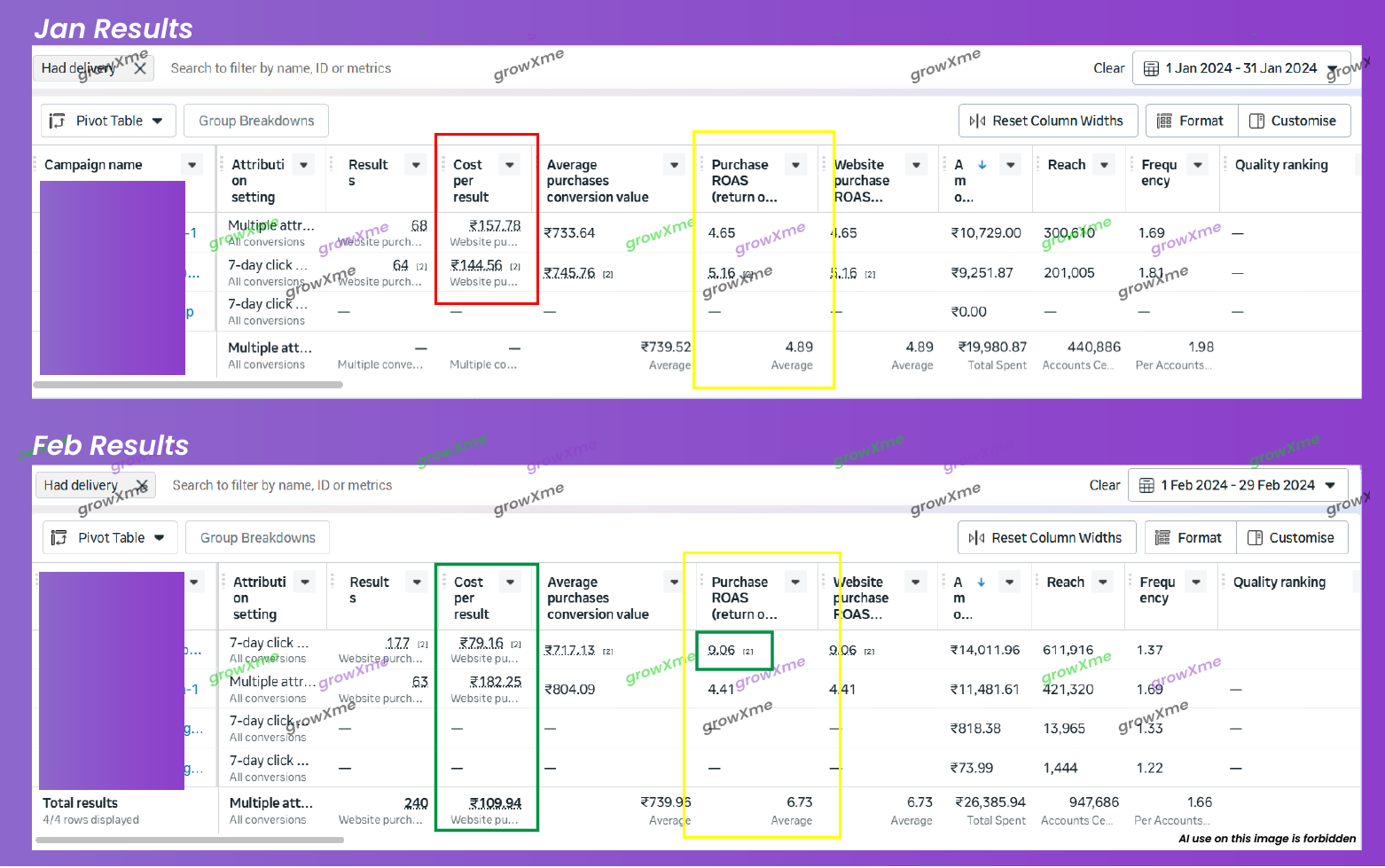
Note: Certain details have been blurred for confidentiality.
KEY RESULTS SNAPSHOT
CPA ↓
~50%
Reduced after eliminating inconsistent campaigns and consolidating spend into stable performers
AOV ↑
~45%
Increased due to improvements in on-site conversion and stronger product–creative alignment
Ad Spend ↑
~12x
Scaled by increasing budgets only on campaigns meeting CPA thresholds
ROAS ↑
~9x
Peaked and sustained for a month during the most stable phase after signal quality improved
THE CONTEXT
The brand operated in the D2C eCommerce space with limited usable learnings across both the ad account and the store.
- Moderate AOV with healthy product margins
- A mix of products with inconsistent performance
- Unable to consistently generate 10+ sales per day
Campaigns were active, but results were inconsistent. Performance fluctuated without clear signals, making it difficult to determine what was working and what could scale.
THE CORE CHALLENGE
Campaigns lacked clear visibility into signal quality and volume, making it difficult to determine whether performance was scalable or just short-term variance.
No Profit Framework
Campaigns were not tied to a defined maximum allowable CPA, so there was no clear threshold to determine what was profitable, what could scale, and what needed to be stopped.
Misaligned Campaign Objectives
Campaigns were optimized for traffic and engagement, bringing in low-cost clicks but low-intent users who did not convert into meaningful revenue.
High Performance Variation
Results were inconsistent. Some campaigns performed well while others exceeded viable acquisition costs, with no system to identify and scale repeatable winning patterns.
OUR APPROACH
Meta Ads scaling isn’t about increasing spend — it’s about building a system that can absorb spend without breaking your CPA.
Most accounts fail at scale because they lack structure. Campaigns are tested without clear thresholds, budgets are increased without validated signals, and performance becomes unpredictable.
Instead of chasing short-term ROAS, we built a controlled acquisition system centered around Signal Velocity and High-Velocity Readiness (HVR) — ensuring campaigns generate consistent, decision-grade signals before scaling is introduced.
NOT SURE WHY YOUR CPA BREAKS WHEN YOU SCALE?
If your account isn’t generating enough high-quality signals per unit time, scaling will always introduce volatility — regardless of platform or budget.
We evaluate your campaigns through a Signal-Velocity lens to identify whether your system is actually ready to scale — or just reacting to unstable performance.
GET A STRUCTURED BREAKDOWNThis system-first approach ensures that scaling decisions are based on validated signals, not short-term performance spikes — enabling stable growth as spend increases.
GROWTH SYSTEM IMPLEMENTATION
Profitability Framework
We defined a clear acquisition cost ceiling based on contribution margin, incorporating product costs, fulfillment, and payment-related expenses. This allowed us to determine sustainable acquisition thresholds.
Conversion-Focused Campaigns
We transitioned from traffic campaigns to purchase-optimized structures, ensuring that the algorithm optimized for revenue rather than low-quality engagement.
Signal Identification
Campaigns were evaluated using a Signal-Velocity lens to isolate scalable patterns across creatives, audiences, and products.
System Stabilization
Spend was consolidated into proven campaigns, reducing variability and creating consistent acquisition costs.
The result of this structured approach is reflected in the ROAS progression below:
Key takeaway: Revenue efficiency improved significantly as the system matured, with ROAS scaling from sub-profitable levels to consistently high returns.
SCALING & EXPERIMENTATION
With a stable system in place, structured experimentation was introduced through UGC creatives, retargeting strategies, and automated campaign formats.
Not all tests performed well, but each was evaluated against the CPA threshold, ensuring that experimentation remained financially controlled.
This progression reflects increasing signal stability and improved High-Velocity Readiness across campaigns.
Key takeaway: Despite increased spend, acquisition costs were stabilized and reduced, demonstrating controlled and sustainable scaling. Lower CPA was a byproduct of improved signal density and cleaner optimization inputs.
PERFORMANCE AT SCALE
- Ad spend increased significantly while maintaining efficiency
- CPA remained within profitable limits
- AOV increased due to improved purchase behavior
In addition to performance gains on the ad side, improvements in purchase behavior led to a steady increase in AOV:
Key takeaway: Improvements in purchase behavior and funnel efficiency led to a consistent increase in AOV, strengthening overall profitability.
FINAL TAKEAWAY
Profitable scaling was achieved by operating within clear CPA constraints and making decisions based on consistent signal quality rather than short-term performance fluctuations.
Campaigns were only scaled when they demonstrated stable acquisition costs and sufficient signal density, ensuring that increased spend did not compromise underlying unit economics.
Before
- No defined CPA threshold or profitability framework
- Campaigns optimized for traffic and engagement
- Low-quality signals with inconsistent performance
- Scaling increased spend but reduced efficiency
After
- Defined CPA constraints based on contribution margin
- Purchase-optimized campaigns aligned with revenue
- Stable signal density enabling predictable performance
- Ad spend scaled ~12x while maintaining efficiency
- CPA reduced by ~50% with peak ROAS reaching ~9x
The result was a system that could absorb spend without breaking CPA constraints, enabling controlled and repeatable growth.
OPERATIONAL TAKEAWAYS
If your campaigns are struggling to scale or maintain efficiency, these are the exact actions that made the difference in this case:
- Define a maximum allowable CPA based on contribution margin before scaling any campaign
- Stop optimizing for traffic or engagement if your goal is revenue — align campaigns to purchase events
- Do not increase budgets unless campaigns are consistently hitting CPA targets over a meaningful sample size
- Identify repeatable patterns across creatives, audiences, and products before scaling spend
- Consolidate spend into proven campaigns instead of spreading budget across too many variables
- Evaluate experiments based on profitability, not just performance spikes or short-term ROAS
- Prioritize signal quality and stability over low CPI or cheap traffic
If your campaigns are struggling to meet these conditions consistently, the issue is rarely effort; it’s structure.
SCALING ADS SHOULDN’T BREAK YOUR MARGINS
Most brands don’t struggle with running ads — they struggle with scaling them profitably.
If your acquisition costs are unpredictable or rising as you scale, it’s usually a system problem — not a platform problem.
• Quick breakdown of your current ad performance
• Identify gaps in your acquisition system
• Walk away with actionable next steps (even if we don’t work together)
No sales pressure. Just a strategic conversation based on your numbers.
These are the most common questions US ecommerce brands ask when trying to scale Meta Ads profitably.
FREQUENTLY ASKED QUESTIONS ABOUT SCALING META ADS
Answers to common questions around Meta Ads scaling, CPA vs ROAS, and building profitable acquisition systems.
How do you scale Meta Ads profitably?
Scaling Meta Ads profitably requires defining a maximum allowable CPA based on contribution margin. Instead of relying only on ROAS, high-performing accounts identify scalable signals, reallocate budget toward proven performance, and maintain strict cost control during expansion. See how this works in practice in our growth marketing approach.
What is Signal Velocity in Meta Ads?
Signal Velocity is the speed at which your account generates conversion events such as purchases, installs, or sign-ups to train the algorithm. High velocity helps Meta exit the learning phase faster, while low velocity leads to inconsistent performance and unstable results. Maintaining sufficient signal density allows these signals to translate into predictable and scalable growth. Learn more about this in our Signal-Velocity framework.
How do you know if a Meta Ads campaign is ready to scale?
A campaign is ready to scale when it delivers stable CPA, consistent conversion volume, and repeatable performance across multiple days. Sufficient signal volume and low volatility indicate that the system can handle increased budget without breaking efficiency. See how we validate this in our scaling framework.
Why do Meta Ads become more expensive when scaling?
Meta Ads often become more expensive during scaling because the algorithm expands into broader audiences and lower-intent segments. Without strong signal density and creative performance, this expansion leads to higher CPAs and reduced efficiency. Learn how we control this using our signal-based model.
What causes CPA to increase when scaling ads?
CPA typically increases when signal quality drops, audience saturation occurs, or budget is increased too aggressively. Weak creative performance and insufficient conversion data can reduce optimization efficiency and increase acquisition costs. This is addressed in our Signal-Velocity framework.
CPA vs ROAS: which metric matters more for Meta Ads?
CPA is often more critical than ROAS when scaling Meta Ads. While ROAS measures revenue efficiency, CPA determines whether customer acquisition is sustainable based on contribution margin. Many brands scale successfully by optimizing toward CPA thresholds rather than chasing higher ROAS. This principle is a core part of our scaling approach.
What is a good CPA for ecommerce brands in the US?
A good CPA depends on contribution margin, not industry benchmarks. For US ecommerce brands, the goal is to define a maximum allowable CPA after accounting for product costs, fulfillment, and payment fees to ensure sustainable growth. We break this down further in our profitability framework.
How long does it take to scale Meta Ads campaigns?
Scaling typically involves an initial testing phase of 2 to 6 weeks, followed by identifying scalable signals and gradually increasing budget. Sustainable scaling usually occurs over several months, depending on data volume and creative performance. See how this plays out in our full case study.
What role does creative play in scaling Meta Ads?
Creative is a primary driver of Meta Ads performance. High-performing formats such as UGC ads improve engagement and conversion rates. Systematic iteration on winning creatives allows campaigns to scale while maintaining efficiency. This is part of our creative testing system.
Can you scale Meta Ads without increasing CPA?
Some increase in CPA is expected during scaling. With a structured system focused on signal quality and optimization stability, campaigns can scale while keeping CPA within controlled and profitable limits. Learn how in our Signal-Velocity framework.
Does this Meta Ads strategy work for US ecommerce brands?
Yes. While CPMs and costs vary, the core principles of Meta Ads scaling apply across ecommerce brands in the US market. These include defining CPA thresholds, identifying scalable signals, and maintaining cost control. See it applied in our case study.
What makes a Meta Ads campaign scalable?
A scalable campaign has stable CPA, consistent conversion rates, repeatable creative performance, and sufficient signal volume. Scalability is achieved when performance remains predictable as ad spend increases. This ties into our signal-based scaling model.