
How To Evaluate a Meta Ads Agency for Your Ecommerce Brand
Most agencies can report what happened. The better question is whether they can diagnose why it happened.
A good agency should not only launch campaigns, adjust budgets, and send reports. It should help you understand whether your Facebook Ads performance is being limited by campaign structure, creative testing, offer quality, Shopify tracking, landing page friction, checkout behavior, or whether the account is being pushed to scale before it is ready.
If you are choosing a new agency, questioning your current one, or wondering whether the answers you are getting are too vague, use this as a practical evaluation guide.
Quick Answer: What Should a Good Meta Ads Agency Do?
A good Meta Ads agency for ecommerce should be able to explain what is changing, why it is changing, what the account is learning, and what constraint needs to be fixed next.
If the agency only reports CPM, CTR, CPC, ROAS, and CPA without explaining the buying path, tracking quality, creative learning, offer fit, and scale-readiness, you may be getting campaign activity instead of growth diagnosis.
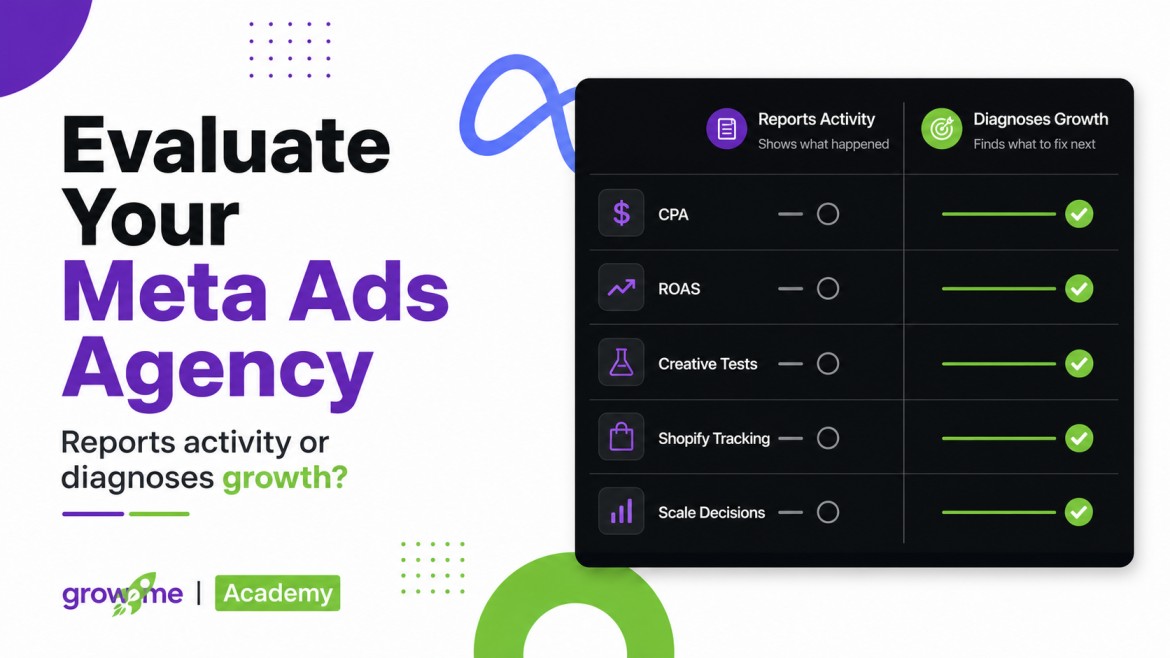
The Diagnosis Gap: Reporting What Happened vs Explaining Why It Happened
The Diagnosis Gap is the difference between an agency that can report what happened and an agency that can explain what is actually limiting profitable growth.
- Spend changed.
- CTR moved.
- CPA increased.
- ROAS dropped.
- New ads launched.
- Why CPA changed.
- What signal changed.
- Which layer is limiting growth.
- Whether spend should hold or scale.
- What decision comes next.
Reality Check
A lot of ecommerce brands do not leave agencies because campaigns were never touched. They leave because spend kept moving, reports kept arriving, and nobody could clearly explain what was breaking: the account, the offer, the tracking, the creative, the buying path, the scale decision, or the market.
If every monthly call creates more changes but not more clarity, the agency may be managing motion instead of improving the system.
10 Questions To Ask Before Hiring or Switching Meta Ads Agencies
Use these questions in a sales call, monthly review, or second-opinion discussion.
What do you check before changing campaign structure?
How do you diagnose rising CPA?
How do you explain ROAS drops after scaling?
How do you compare platform reporting with Shopify?
What does your creative testing process actually test?
How do you know if a test has enough signal?
When would you tell us not to spend more?
What ecommerce economics do you need before making decisions?
How do you handle tracking gaps or Pixel/CAPI issues?
What would make you recommend an audit before a retainer?
What a Strong Agency Should Be Able To Explain
These are the evaluation areas that separate useful paid social strategy from simple account maintenance.
Can They Diagnose Rising CPA?
When CPA rises, weak answers sound like “Meta is volatile” or “CPMs are up.” A better agency separates creative fatigue, signal quality, traffic quality, offer friction, tracking issues, and scale pressure.
What a useful answer sounds like
“CPA rose after spend increased, but conversion volume did not rise with it. Before we call this market pressure, we need to check whether the account lost purchase signal consistency, whether the creative is reaching colder demand, and whether Shopify orders match platform-reported purchases.”
Can They Explain ROAS Drops After Scaling?
ROAS often drops when budget expands beyond the easiest demand. A useful agency should explain whether added spend created proportional output, weaker demand, more frequency pressure, or disrupted learning.
What a useful answer sounds like
“The question is not only whether ROAS dropped. The question is whether the next layer of spend produced enough incremental sales to justify the lower average return. If marginal output weakened, we should stabilize the winning path before adding more budget pressure.”
Can They Explain What Creative Tests Are Learning?
Creative testing is not uploading more ads and hoping one works. The agency should know whether it is testing a hook, offer, proof, objection, format, or purchase-intent angle.
What a useful answer sounds like
“This test is not just three new videos. One angle tests product proof, one tests the objection around price, and one tests urgency. We will judge it by purchase signal quality, not by engagement alone.”
Do They Compare Reporting With Store Data?
For ecommerce, a serious review compares platform reporting with Shopify orders, UTMs, payment data, attribution breakdown, event timing, and missing or duplicate events.
What a useful answer sounds like
“Meta reporting is useful, but it is not the only source of truth. We should compare attributed sales, click-based conversions, view-based conversions, UTMs, and actual store orders before deciding whether performance is real or inflated.”
Do They Understand Your Ecommerce Economics?
A campaign can look good in Ads Manager and still be weak for cash flow. CPA, AOV, contribution margin, MER, refunds, discounts, shipping, and repeat purchase behavior matter.
What a useful answer sounds like
“Before we call this campaign profitable, we need to know the target CPA after contribution margin, discounts, shipping, refunds, and repeat purchase value. Platform ROAS alone does not tell us whether the brand is actually making money.”
Do They Look Outside Ads Manager?
Some paid social problems live on the product page, checkout, offer, comments, trust signals, stock status, shipping expectations, or country and market fit.
What a useful answer sounds like
“The campaign may be doing its job if it is bringing qualified attention. Now we need to check whether the page keeps the same promise, whether the offer is still live, whether the product is available, and whether checkout friction is killing the sale.”
Do They Know When To Wait, Fix, Or Cut?
A good agency should not panic-edit the account every time performance moves, but “wait longer” is not always the right answer either.
What a useful answer sounds like
“If this is a structural change, we should let the first learning shock settle before judging. But if the link is broken, tracking is missing, the product is out of stock, or spend is passing a no-signal guardrail, waiting is not discipline. It is waste.”
Do They Protect Working Campaigns During Scaling?
Scaling can change the learning environment. New ad sets, offers, audiences, or budget shocks can disrupt the path that was already producing sales.
What a useful answer sounds like
“The winner is working because the campaign has a stable learning path. If we introduce a new offer, audience, or ad set into the same budget pool, we need to protect the existing signal flow instead of letting the test steal spend from the proven path.”
Real Account Patterns a Good Review Should Catch
These examples are the kind of practical diagnosis that rarely shows up in generic agency pages.
A New Ad Set Stole Spend From the Winner
In small CBO campaigns, a new ad set can pull budget away from the winning ad set and disrupt the learning path that was producing steady sales.
69 Platform Sales vs 14 Visible Store Orders
When platform and Shopify numbers disagree, the useful question is not which number looks better. It is what the attribution breakdown and source-of-truth data actually show.
The Account Learned the Wrong Behavior
Accounts trained around traffic or add-to-cart behavior can become good at finding clickers or cart-adders instead of buyers.
The Ad Promise Changed After the Click
If an ad sells an old bundle, discount, or promise while the page has changed, the buying path is broken before the campaign can be judged fairly.
Instagram Engagement Did Not Become Sales
Engagement can look strong while purchase intent stays weak if the creative, product proof, comments, or checkout path does not support the promise.
The Offer Made Sense in the Wrong Market
A campaign can fail when creative, seasonality, website messaging, and local buyer context do not match the audience being targeted.
Red Flags When Evaluating a Meta Ads Agency
One red flag does not always mean you should switch. Several together usually mean you need a deeper review.
- They blame the algorithm before checking the buying path.
- They cannot explain why CPA or ROAS changed.
- They talk about CTR and CPC when your problem is profit.
- They cannot explain the optimization event.
- They ignore product page, offer, checkout, or tracking issues.
- They do not compare platform results with Shopify or backend data.
- They launch creative tests without a clear learning question.
- They make constant changes without decision rules.
- They push more spend before checking signal quality.
- They sell revenue share or commission-only as if strategy is free labor.
Not Sure If Your Agency Is Diagnosing the Right Problem?
Sometimes the right move is not hiring a new agency immediately. A structured Meta Ads Audit can show whether the problem is campaign execution, signal quality, creative testing, offer friction, tracking, market pressure, or the business economics around the ads.
GrowXme can review the account, tracking, creative system, offer, buying path, and scale-readiness so you can see what to fix before more budget gets pushed into the same unclear system.
- The account story is unclear.
- CPA rose and nobody can explain why.
- ROAS dropped after scaling.
- Shopify and platform reporting disagree.
- Your current agency’s answers feel vague.
- The account has been edited too often.
- You suspect the issue may be offer, tracking, or funnel quality.
- You need a second opinion before switching agencies.
FAQ
How do I know if my Meta Ads agency is doing a good job?
A good Meta Ads agency should explain what changed, what was learned, what is limiting performance, and what decision should come next. If the agency only reports metrics without diagnosing the buying path, tracking, creative learning, offer fit, and scale-readiness, start with a structured Meta Ads Audit before adding more budget.
What should a Facebook Ads agency report include?
A useful report should include CPA, ROAS, spend, revenue, conversion volume, creative test learnings, tracking notes, Shopify or backend comparison, what changed, what was learned, and what decision is recommended next.
Should my agency handle Shopify tracking and Pixel issues?
Your agency should at least be able to diagnose whether tracking is affecting campaign learning and coordinate the right fix with your store, developer, or platform setup. If the account story is unclear, use this agency, offer, or market diagnosis to separate tracking issues from broader business constraints.
Is creative testing part of Meta Ads management?
Yes. Creative testing is central to ecommerce paid social, but it should be structured around clear questions, buyer intent, offer clarity, product proof, and useful learning. GrowXme’s Creative Testing Map is built around that decision process.
When should I get a Meta Ads audit?
Get a Meta Ads Audit when CPA is rising, ROAS is unstable, reporting does not make sense, the account has been changed too often, or you are not sure whether the problem is your agency, offer, tracking, market, or account structure.
Should I switch agencies if performance drops?
Not always. First, diagnose whether the problem is agency execution, offer quality, tracking, market pressure, creative fatigue, or account structure. If your agency cannot explain the likely cause or the next decision, compare that against what a stronger ecommerce Meta Ads agency should be able to do.
What if my Facebook Ads CPA suddenly increased?
A sudden CPA increase can come from auction pressure, creative fatigue, tracking gaps, offer mismatch, weak conversion volume, or scaling pressure. Use this guide on why CPA suddenly increased in Meta Ads to diagnose the likely layer.
What if ROAS dropped after increasing budget?
ROAS can drop after scaling when the account moves beyond the easiest demand, loses signal consistency, or adds spend faster than the system can learn. Read why ROAS drops when you increase budget for the full scaling diagnosis.
Can an agency fix Instagram engagement that does not turn into sales?
Sometimes. The agency needs to diagnose whether the issue is creative intent, landing page match, product proof, comments, trust, checkout friction, or low-intent traffic. This is the same buying-path problem covered in Meta Ads getting clicks but no sales.
How do I know if my ad account is ready to scale?
Look at signal consistency, conversion volume, tracking reliability, CPA stability, creative learning, and whether added spend creates useful incremental output. The HVR Readiness Calculator gives you a quick starting point.